
Simulation Services for PORt Engineering, Efficiency, Efficacy, Availability for Logistics
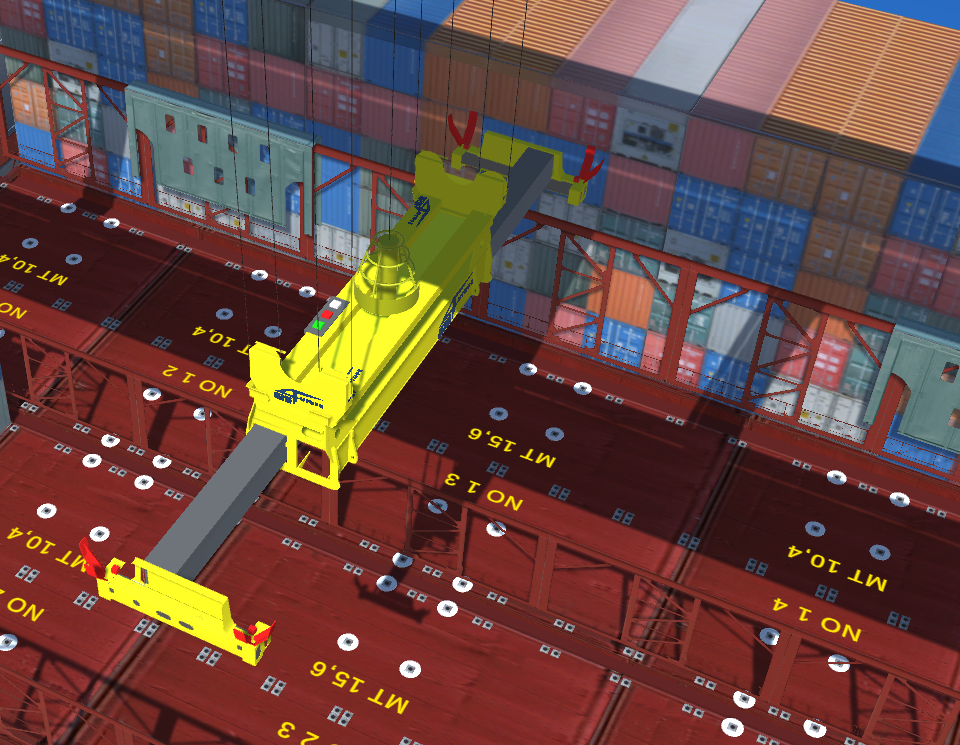
This project delivers a high-fidelity simulation and training platform for Ship-to-Shore crane operations, designed to recreate realistic container terminal workflows in a safe, controlled, and measurable environment. Built for port terminals, equipment manufacturers, and training institutions, the platform combines immersive visual systems, industrial control interfaces, a motion platform, and physics-based simulation to reproduce real crane handling conditions with a high degree of operational realism.
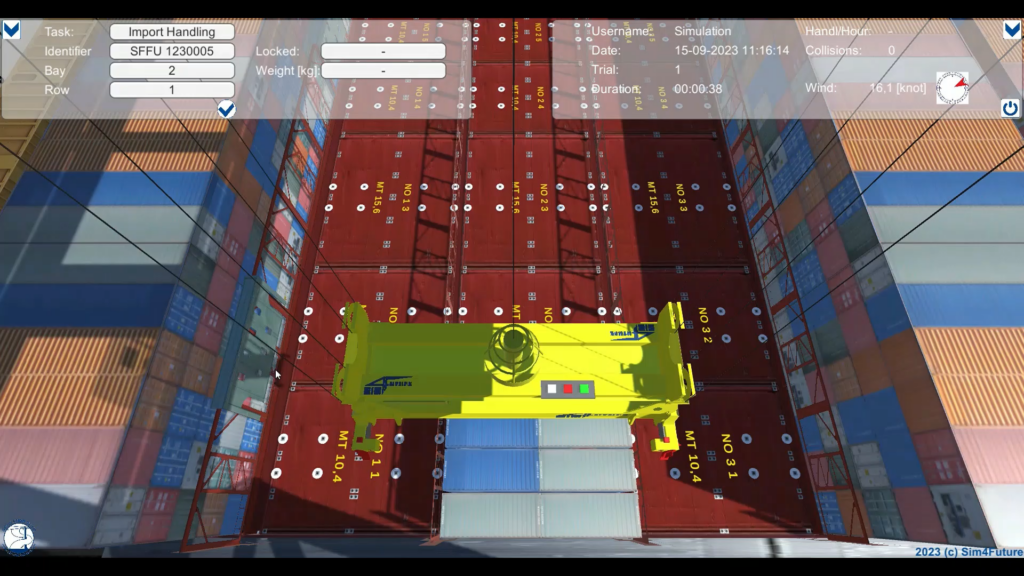
Operators can perform full loading and unloading missions across variable weather, visibility, vessel, and container configurations, while progressing through scenarios of increasing difficulty. This allows the system to support not only practical operator training, but also procedure refinement, skills assessment, and structured scenario testing without disrupting live port activity.
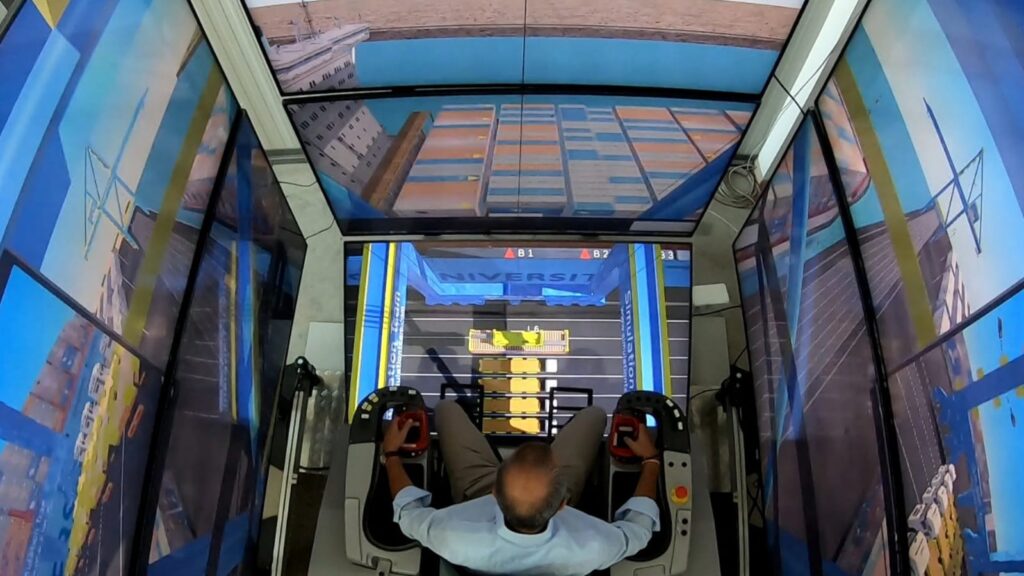
A key commercial advantage is the ability to shift a meaningful share of training away from live equipment and into a digital environment that is safer, more flexible, and significantly less energy-intensive. By comparison, published industry references show that modern STS cranes can consume material amounts of electricity per move and operate with substantial auxiliary power demand, whereas the simulator itself operates at around 2 kWh. That makes it possible to train more frequently, repeat complex missions, and evaluate performance with far lower operating energy requirements than live-equipment training.
The platform is built around measurable assessment. It records mission outcomes, collisions, productivity, movement quality, timing, and scenario conditions through a KPI-based framework, generating structured performance data that can be reviewed over time. This creates a more evidence-based training process, giving operators, instructors, and stakeholders a clearer basis for benchmarking progress and improving results.
Unlike lighter simulation offers that focus mainly on visualization or basic familiarization, this platform is positioned as a more flexible, scientifically grounded training environment. Its value lies not only in realism, but in the combination of immersive operation, configurable mission design, progressive difficulty, and measurable performance analytics. The result is a more defensible approach to operator development: one that supports better validation, stronger training design, and higher confidence in outcomes.
Referfences
Bruzzone, A. G., Massei, M., Sinelshchikov, K., Ferrari, R., & Cardelli, M. (2023). New Generation Interoperable Simulators for Port Operations. In proceedings of 35th European Modeling and Simulation Symposium, EMSS 2023. doi: 10.46354/i3m.2023.emss.045
Funding
“TECHLOG -Technological Transfer for Logistics Innovation in Mediterranean area” B_A.2.1_0175 CUP F95F20000350006, finanziato nell’ambito del Programma ENI CBCMED, all’Università degli studi di Cagliari (CIREM)