
Global Actual Analytics based on Advanced Artificial Intelligence
GA4I is a quantitative scenario simulation and forecasting platform that helps strategic analysts, risk teams, and decision-makers understand how complex geopolitical situations are likely to evolve and what difference their actions can make.
GA4I shows you where indicators are heading, across multiple countries simultaneously, over a forecasting horizon of weeks to months, and lets you test intervention options before committing to them.
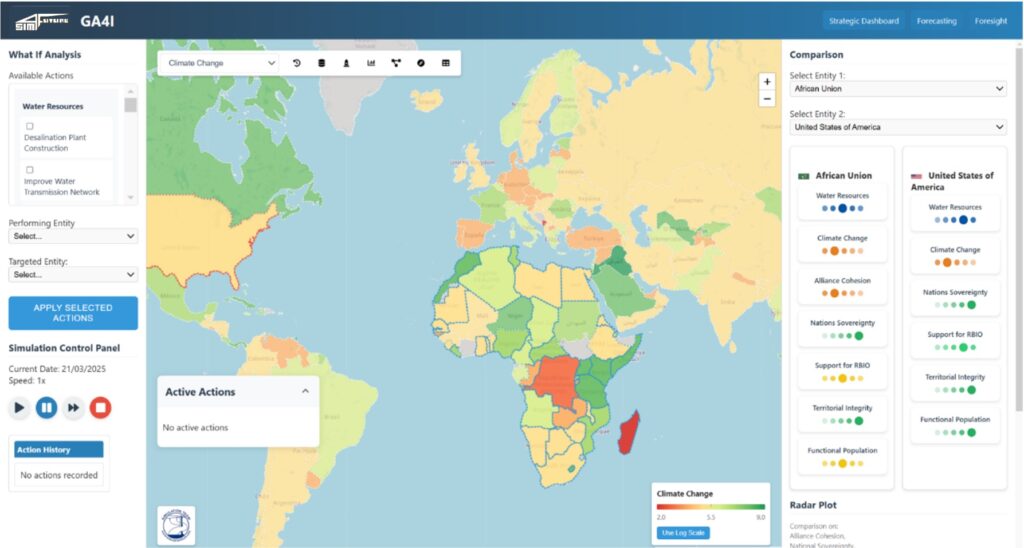
GA4I addresses the needs of organizations that operate in complex, uncertain environments where decisions carry high consequences:
- Defense and security organizations — strategic planning staffs, intelligence analysis teams, crisis simulation and wargaming centers
- Energy and critical infrastructure operators — companies needing to model geopolitical risk to supply chains, anticipate cascade effects of sanctions or conflict, and stress-test operational exposure in volatile regions
- Financial services and insurance — banks, asset managers, insurers, and reinsurers requiring quantitative, forward-looking scenario analysis for portfolio stress-testing, country risk assessment, and political risk pricing


How it works
GA4I models countries, coalitions, and operating environments as networks of interconnected variables, each initialized with real-world data drawn from the CIA World Factbook, World Bank datasets, and UN databases — ensuring that every simulation starts from an empirically grounded baseline rather than analyst assumptions.
The variable set spans four domains:
- Economic — GDP and growth trajectory, energy dependency, unemployment rate, and population dynamics
- Military — relative military capability and armed forces cohesion
- Political — corruption index and governance stability
- Social — influence propagation, public sentiment shifts, and the effect of strategic communications across target populations
A hybrid simulation engine combines system dynamics, capturing how these variables influence each other over time across borders and coalitions, with intelligent agents that replicate the behavior of individual actors under uncertainty. A change in energy dependency in one country, for example, cascades through trade relationships, alliance cohesion, and governance stability in connected states, producing emergent dynamics that linear analysis cannot anticipate.
The result is a living model of a scenario that evolves stochastically over a forecasting horizon that varies from several months to a year, reflecting real-world unpredictability.
GA4I is built around three integrated modules:
Simulation Engine
The foundation of the platform. The user configures a scenario by selecting the countries and coalitions of interest, setting initial conditions based on real-world data, and defining the actions to be applied. Once launched, the simulation runs a stochastic model of how the configured variable network evolves over time, propagating the effects of each action across economic, military, political, and social dimensions simultaneously.
Forecasting
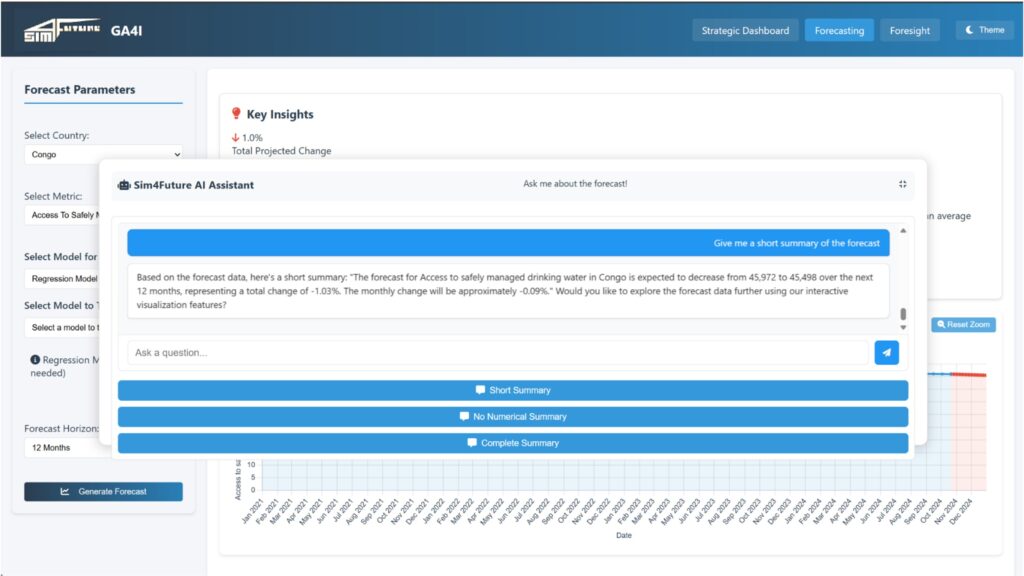
The forecasting module allows users to select any variable in the system and generate a forward-looking prediction over the chosen time horizon that varies from 3 to 12 months. Forecasts are produced by a combination of statistical time-series models and AI-based prediction, automatically selecting the most appropriate method for the variable and data context in question.
Foresight
This is the Design of Experiment module that allows to ask “across all the things I could do, which ones actually move the needle and by how much?” This tool allows to systematically run the simulation across a structured matrix of action combinations, applying a full factorial experimental design to explore thousands of scenario variants automatically. The output identifies which actions, or combinations of actions, produce the greatest impact on the outcomes that matter.

AI Assistant
GA4I includes a built-in AI assistant, accessible through a natural language chat interface directly within the platform. Its role is to make simulation outputs immediately interpretable, without requiring the user to manually parse charts, probability distributions, or scenario ensembles.
The assistant can be queried in natural language about any aspect of the results: why a specific metric evolved the way it did, which variables drove a particular outcome, how two scenarios compare, or what the most significant dynamics in the current run are.
Deployment model
GA4I is offered as a customizable, project-based solution adaptable to specific organizational workflows, data environments, and analytical requirements. Engagement options include configured pilot projects, scenario-as-a-service deliverables, and platform integration for organizations seeking to embed geopolitical scenario analysis into existing risk or decision-support workflows.
What you can simulate
Users can apply intervention actions to the scenario and observe how the system responds over the time horizon. The current action set includes:
- Diplomatic sanctions and normalization
- Cyber operations
- Trade embargoes
- Counter-terrorism operations
- Humanitarian aid deployment
- Counter-intelligence operations
- Psychological and influence operations
- Sabotage and infiltration scenarios
- Anti-satellite operations
Each action propagates through the simulation network reflecting historical patterns and system dynamics.
Scenario examples
Impact of Western sanctions on a major energy-exporting nation
Configure a coalition of sanctioning countries and a target economy. GA4I forecasts the evolution of trade dependency, sovereign stability, and alliance cohesion over the following months and compares outcomes across sanction intensity levels. Useful for assessing whether a sanctions package achieves its strategic objectives or generates unintended second-order effects.
Escalation dynamics in a contested maritime region
Model a multi-actor scenario involving competing territorial claims and external power involvement, for example in the Indo-Pacific or Eastern Mediterranean. Simulate how diplomatic pressure, military posturing, or humanitarian engagement by different actors shifts the probability distribution of escalation or de-escalation.
Coalition stress-testing ahead of a major geopolitical shock
Before a significant event, an election, a summit, a threatened embargo assess the fragility of an alliance by running the simulation across multiple stress scenarios. Identify which member states are most likely to defect, hedge, or shift alignment, and under what conditions.