
Simulator for interPORT Training
The Reach Stacker Simulator is a compact training system designed to introduce operators to real terminal operations in a safe, controlled, and cost-efficient environment.
It reproduces the operational workflow of an intermodal yard, allowing trainees to perform loading, unloading, and positioning tasks across trains, trucks, and storage areas using realistic controls and a full visual field.
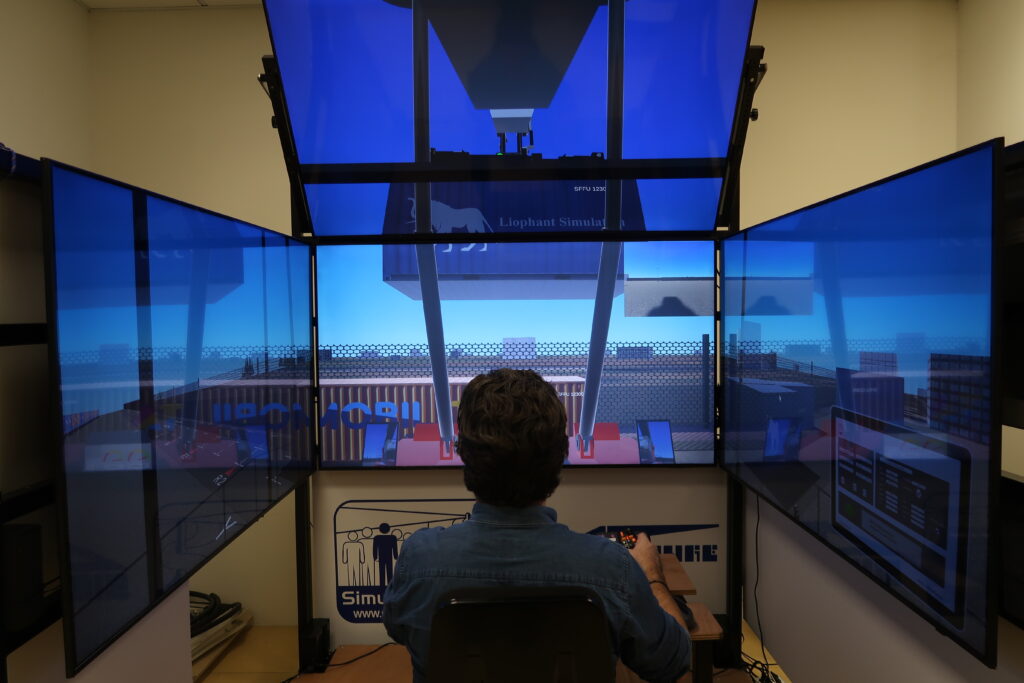
The system is already in use within structured training programs and has been validated with professional operators, supporting skill acquisition and operational familiarization.
The simulator is positioned as the initial phase of operator training, where users build core handling skills and situational awareness before moving to real equipment. This approach removes the constraints and costs associated with live machine usage while enabling continuous, uninterrupted training cycles under instructor supervision.
From an operational standpoint, the system requires only an instructor to run sessions. Training does not depend on machine availability, fuel consumption, maintenance cycles, or risk exposure. At the same time, the platform records all operator actions, allowing instructors to monitor multiple trainees efficiently and review performance in detail, ensuring that no error or behavior goes unnoticed, by analyzing the results:
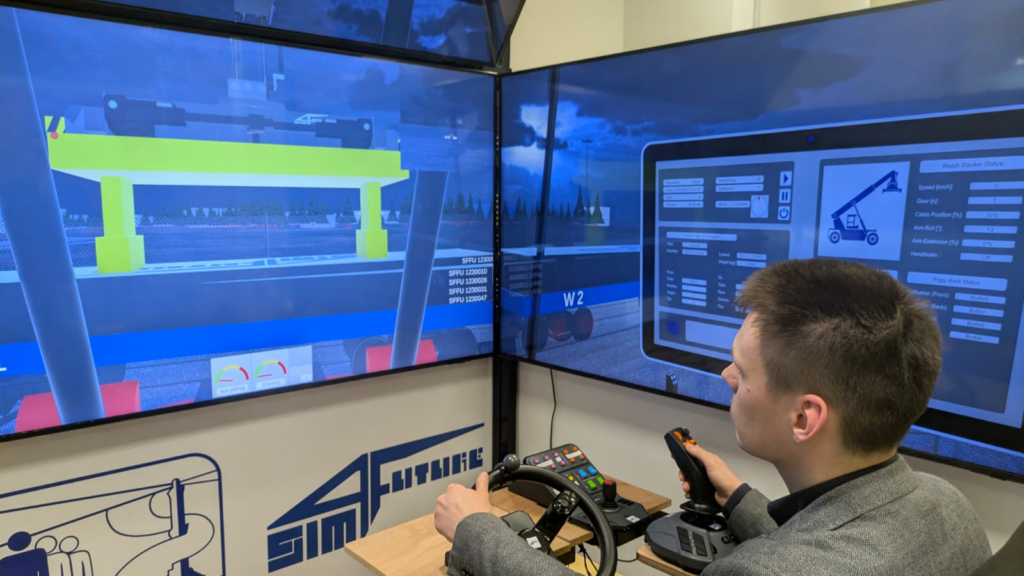
The physical configuration replicates the operator environment using a combination of control interfaces and immersive visualization. A multi-screen setup provides a wide field of view, including critical upper frontal visibility required in reach stacker operations, which is not achievable with standard desktop systems. A motion platform introduces dynamic feedback, improving perception of load balance, inertia, and the consequences of incorrect maneuvers such as impacts or unstable handling. This significantly enhances learning compared to static or purely virtual solutions, while also reducing simulator-induced discomfort and enabling longer training sessions.
The use of industrial-style gaming controllers ensures a practical balance between realism and system cost, making the solution accessible without compromising training effectiveness.
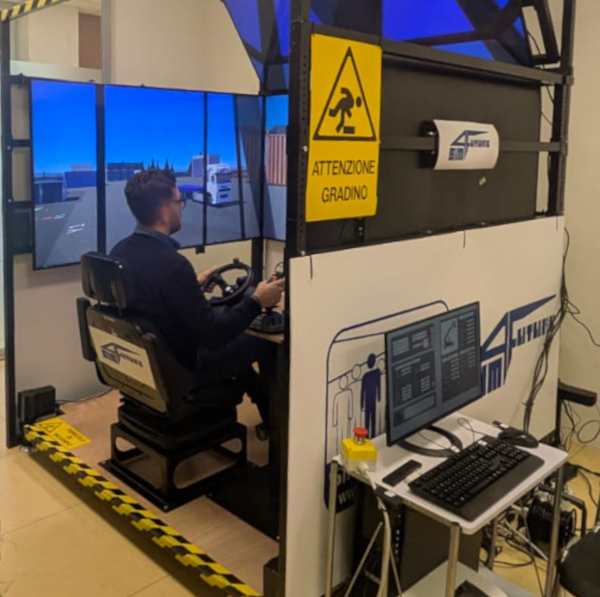
The system is delivered as a standalone unit, requiring approximately 4×4 meters of space, including operator access. It is designed for single-user operation, with a local architecture that ensures full data privacy and independence from external infrastructure. This makes it particularly suitable for institutional environments such as technical training centers and academies, where controlled, offline operation is often required.
Two primary use cases are addressed:
Training institutions: advanced practical training tool supporting structured educational programs in logistics and intermodal transport. The simulator supports configurable scenarios and can be adapted to reflect different operational contexts, enabling alignment with specific terminal layouts or training objectives. Performance tracking is integrated into every session. The system generates detailed reports covering execution quality, errors, collisions, and task completion, giving instructors objective data to evaluate progress and guide improvement over time. Beyond technical training, the platform leverages a training-by-gaming approach to increase engagement, particularly among younger users. This improves motivation, retention, and accessibility, helping training providers attract and develop new talent in a sector facing increasing workforce challenges.
Terminal operators: introductory training to familiarize new personnel with equipment behavior and yard workflows before transitioning to live operations.
Funded by Missione 4: Istruzione e Ricerca – Componente 1 del PNRR
SPORT2 is a further expansion of S2PORE4AL.
Referfences
Bruzzone, A. & Sinelshchikov, K. (2024). Immersive XR Simulation for Enhanced Terminal & Port Operations. In Proceedings of 15th International Workshop on Applied Modelling and Simulation (WAMS). ISBN: 979-12-985368-0-7