
City Analysis of Contamination by Tic/Tim Urban Area Simulation
CACTUS is an advanced decision-support and training platform for emergency planners, crisis managers, and response coordinators facing hazardous-release scenarios in urban environments. It combines hazard dispersion simulation, population impact analysis, and interactive 3D visualization in a single operational workflow. It enables multi-day scenario evolution to be evaluated in a matter of minutes.
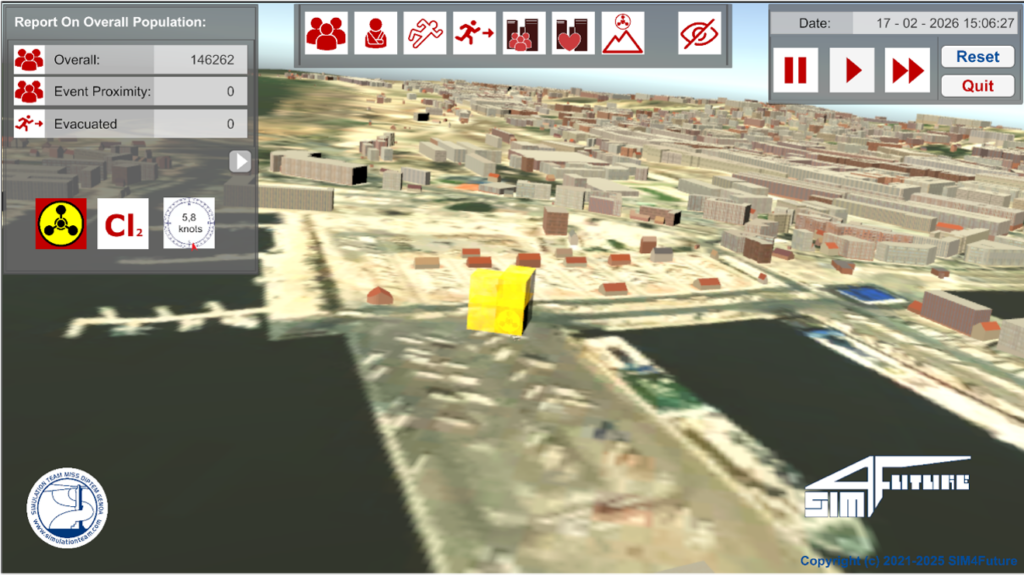
Where traditional tabletop exercises are slow and abstract, CACTUS delivers a realistic, scenario-specific picture of how an incident may unfold: how contamination spreads through complex urban terrain, which populations and infrastructure are most exposed, and how alternative response strategies compare in terms of human impact and operational cost.
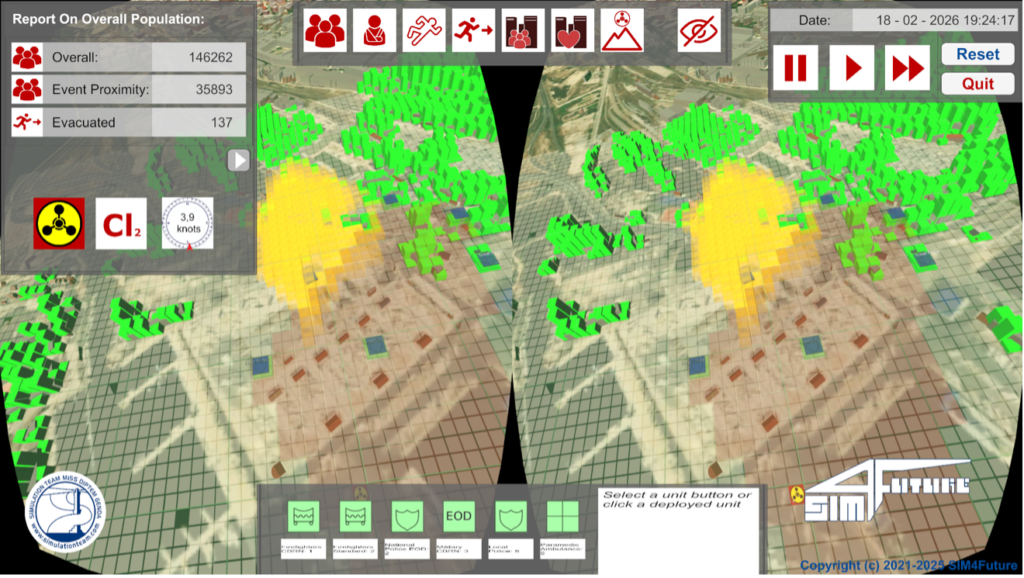
It has an interoperable architecture that combines stochastic modeling with Artificial Intelligence (AI/IA) to simulate intervention strategies, allowing decision-makers to analyze the human impact, operational costs, and the marginal effectiveness of deployed units in real-time
CACTUS enables:
- Rapid scenario analysis, assessing days of incident evolution in tens of minutes
- Population exposure and consequence estimation across affected urban areas
- Comparative evaluation of response options before committing resources
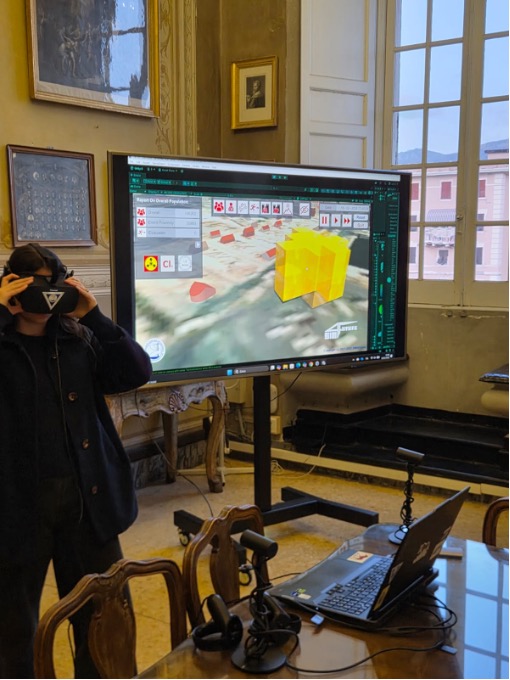
- Immersive training in high-consequence CBRNe and TIC/TIM environments
- Common Operational Picture for multidisciplinary crisis teams
How it works
From incident initialization through dispersion prediction, exposure estimation, infrastructure impact assessment and response simulation, CACTUS guides decision-makers along a clear operational chain; moving crisis management from abstract reports to actionable, evidence-based planning.
The platform integrates physics-based and stochastic dispersion modeling, human behavior simulation, AI-assisted intervention analysis, and immersive 3D visualization. Its interoperable architecture supports integration with broader simulation environments via HLA, making it suitable for federated exercises, distributed training ecosystems, and command-and-control workflows.
A typical use case includes: an industrial accident releases hazardous smoke in a dense urban district. Within minutes, CACTUS maps the contamination spread across city blocks, estimates exposed population by area and demographic group, identifies critical infrastructure at risk, and allows planners to simulate and compare evacuation routes, responder deployment strategies, and shelter-in-place alternatives, before a single unit is moved.
Relevant for
- Civil protection authorities
- Defense and homeland security organizations
- Industrial safety operators
- Urban resilience planners
- Emergency response agencies
- Training centers and academies